Some gigs stay with us because of the music. Others because of the atmosphere. And then there are those we remember for an encounter, a smile, a conversation, a moment shared with the artists.
For an emerging band, that difference can be decisive.
We generally imagine that a gig begins when the lights come on and the first note rings out. We also imagine that it ends with the applause, when the musicians leave the stage.
But the reality is much more interesting.
A gig sometimes begins several days before anyone plays. And it can live on long after the amplifiers have been switched off.
BEFORE THE GIG: THE AUDIENCE IS NOT WAITING FOR YOU YET
Imagine five women musicians getting ready to play at a Brussels café that hosts live music.
They are not famous. They do not have a record label behind them, or a communications team organising their movements.
They have their instruments, their compositions, their rehearsals, their energy and an enormous desire to play.
Their name is on a poster.
But a poster cannot talk.
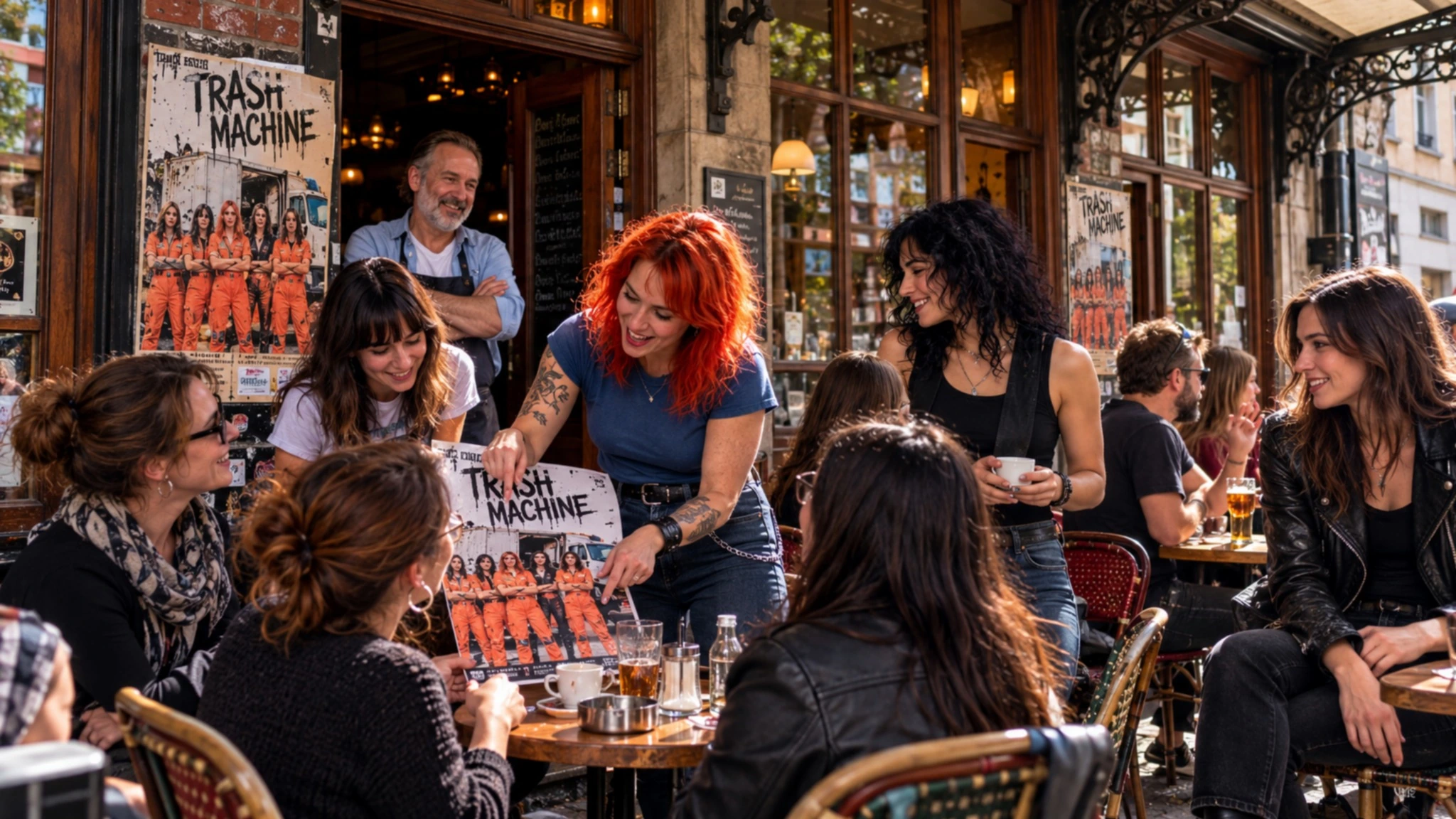
So, a few days before their performance, they drop by the venue.
They say hello to the owner, chat to the staff and sit out on the terrace. They exchange a few words with the regulars. They tell people about their gig, people who may never have heard of them.
No sales pitch. No trying to sell tickets at any cost.
Just a conversation.
“We’re playing here soon. If you like rock, come and listen!”
Their enthusiasm does the rest.
One person asks a question. Another looks at the poster. Someone asks what kind of music they play.
And suddenly a gig that, until then, existed only on a piece of paper starts coming to life in a few people’s minds.
They are not fans yet.
But they are no longer quite strangers, either.
ON STAGE: CHARISMA IS NOT MEASURED IN DECIBELS
The evening of the gig arrives.
There are not fifty thousand people in the room. There are fifty, eighty or a hundred. Some know the band; others have come out of curiosity. A few are simply regulars at the venue.
Yet each one deserves the same energy.
A band is more than five people playing their instruments properly.
It has an identity, an attitude, a way of occupying the space.
The singer can draw the audience in with a glance. The bassist can make her presence felt without saying a word. A guitarist can display an almost provocative defiance. The drummer can impress through her power and concentration.
And none of them has to be like the others.
That is precisely what makes a band interesting: several personalities forming a single musical identity.
The frontwoman, meanwhile, has a particular role.
She is the direct link between the musicians and the audience.
A smile, a joke, a line thrown out between songs, a knowing glance towards someone in the front row: these small gestures can turn a technically accomplished performance into a truly human occasion.
But charisma does not stop at the edge of the stage.
That is precisely where the next part begins.
AFTER THE LAST NOTE: DO NOT DISAPPEAR
The gig is over.
The applause dies down. The lights come back on. People order one last beer, talk about the songs and chat amongst themselves.
The musicians could disappear backstage, pack up their things and go home.
They could.
But why would they?
They have just shared an hour of music with people who gave them their attention.
Now is the time to give them theirs.
The singer comes out into the room, a drink in her hand. She thanks the people who are there. She jokes with a regular. She exchanges a few words with someone who particularly enjoyed one of the songs.
The other musicians join in, each in her own way.
There is no need for the whole band to turn into a public relations team. Some personalities are naturally outgoing. Others are more reserved. That is perfectly fine.
One person can start a conversation and bring the others into that connection with the audience.
And when someone comes over to congratulate the band, a simple “Thank you, that really means a lot to us!” can be worth more than a long speech.
Why?
Because it is sincere.

AN AUTOGRAPH WORTH FAR MORE THAN A SIGNATURE
The evening moves on.
There are fewer people left in the venue.
On stage, the drummer begins taking down her kit. The guitars and bass are already in their cases. Conversations continue around the bar.
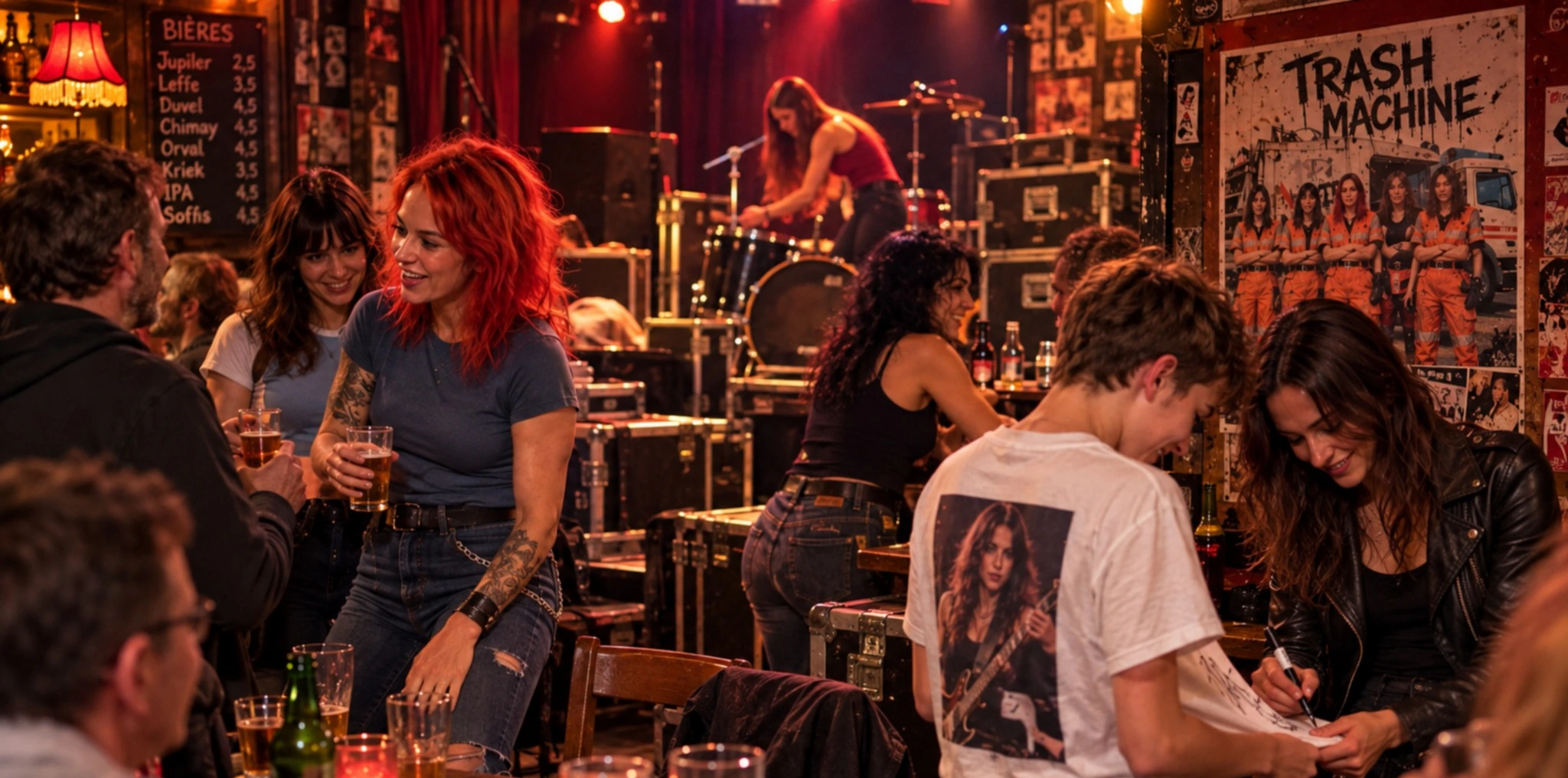
A teenager shyly approaches one of the guitarists.
He must be fourteen or fifteen.
His white T-shirt already carries a photograph of his favourite musician.
He came to see her play.
And now she is there, in front of him.
He asks her for an autograph.
She smiles, takes a marker pen and signs the T-shirt he is wearing, while he carefully holds the fabric taut.
The scene lasts a few seconds.
For the guitarist, it is a friendly gesture at the end of a successful evening.
For the boy, it may be a memory he will keep for twenty years.
Perhaps even longer.
He will tell people he met her. That she spoke to him. That she signed his T-shirt.
He may come back to the next gig. He may bring his friends along.
And it will all have begun with a few seconds of attention.
YOU DO NOT BUILD A LOYAL AUDIENCE THE WAY YOU SELL A PRODUCT
There is a fundamental difference between trying to sell something and making someone want to come back.
An emerging band does not need to turn every conversation into a commercial proposition.
It can have T-shirts, recordings, posters, business cards and a website.
All of that is useful.
But those are only tools.
If someone wants to find the band’s songs again, a simple card with a link or a QR code is enough.
“You can listen to us here. There’s even a video of our last gig.”
And the conversation carries on.
Without pressure.
Someone who enjoyed the music and met approachable artists now has two good reasons to come back.
They are no longer coming just to listen to a band.
They are coming to see people again.
IMAGE MATTERS. SO DOES ATTITUDE.
A band’s visual identity is not limited to its logo or album cover.
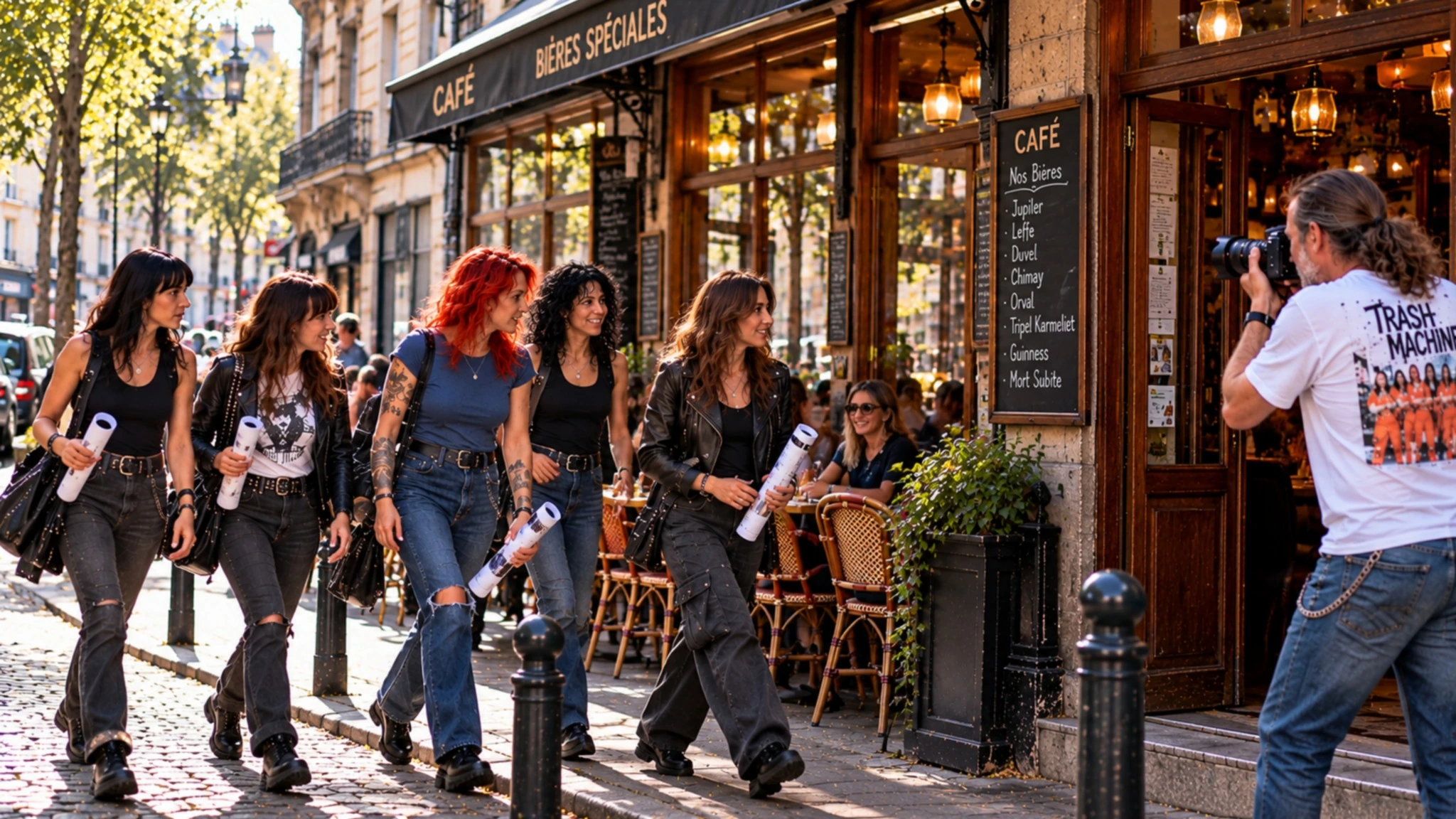
It extends into its clothes, photographs, posters and presence in the places where it performs.
A recognisable jacket, a band T-shirt, a confident look can attract attention before a single note has been played.
But appearance is not enough.
A strong image catches the eye.
Good music holds the ear.
A human approach leaves a memory.
These three dimensions should reinforce one another, not replace one another.
An audience member can be impressed by a musician on stage and, a few minutes later, discover someone warm, funny or simply happy to have played.
That contrast can become a real strength.
AND WHERE DOES THE PRODUCER FIT INTO ALL THIS?
An emerging band rarely has all the skills it needs to navigate every stage of its development on its own.
Composing, rehearsing and playing already take an enormous amount of time.
There is also recording, production, building a sonic and visual identity, preparing communication materials, organising an online presence and learning how to present its work.
That is precisely where an outside perspective can help.
Not to turn the musicians into artificial characters.
Not to impose an attitude that is not theirs.
But to identify their strengths, bring greater coherence to what they do and help them take the next step.
A producer should not try to erase a band’s personality.
They should help it become clearer, stronger and more convincing.
At KRT Production, this approach begins with a conviction: the talent belongs to the artists. The role of production is to give it the means to express itself and be heard.
A band can have excellent music without yet knowing how to present it.
It can have remarkable energy on stage without having built its image.
It can draw fifty people without yet having learnt how to make them want to come back.
These are not necessarily weaknesses.
They are opportunities to grow.
And they do not always require a substantial budget.
Above all, they require attention, commitment, experience and a genuine desire to work together.
THE AUDIENCE IS NOT A STATISTIC
Fifty people in a room are not fifty views on a screen.
They are fifty faces.
Fifty different experiences.
Fifty people who chose to devote part of their evening to your music.
Not all of them will become fans.
But some will return.
Others will talk about you.
A few will follow you for years.
And perhaps a teenager, somewhere in the room, will go home with a T-shirt signed by his favourite guitarist.
That evening, you may not have sold a single record.
But you will have gained something far more precious.
A place in someone’s memory.
Because the gig begins before the first note.
And when it truly succeeds, it does not end with the last.